

SIGSIM PADS 2026 — Call for Papers
June 24-26, 2026, at The Sky, TU Wien (Austria)

The ACM SIGSIM International Conference on Principles of Advanced Discrete Simulation (SIGSIM PADS) focuses on cutting-edge research at the intersection of Computer Science and Modeling and Simulation (M&S). High-quality papers are solicited in all aspects of M&S.
SIGSIM PADS’26 offers a set of thematic tracks (regular and special, the latter provide a novel focus each year), a two-phase submission process (which allows authors to significantly refine and enhance their submissions), an optional artifact review and badging, and the opportunity for authors (based on the decision of the Technical Program Committee) that their paper will be included in a special issue of the ACM Transactions on Modeling and Computer Simulation (TOMACS) which will complement the regular ACM Proceedings of SIGSIM PADS. The figure below illustrates the paper submission and reviewing process.
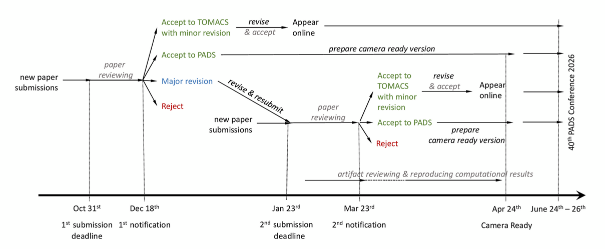
All the submissions are made through EasyChair https://easychair.org/conferences/?conf=acmsigsimpads2026.
For each accepted paper, at least one author must attend the conference and present the work.
All PADS 2026 papers will be published under ACM Open (see below for more details).
Important Dates:
First submission deadline: October 31st, 2025
First notification of acceptance: December 18th, 2025
Second submission deadline: January 23rd, 2026
Second notification of acceptance: March 23rd, 2026
PhD Colloquium abstract: April 3rd, 2026
PhD Colloquium notification: April 17th, 2026
Topics
We encourage submissions that align with the themes below. However, the list is not comprehensive: we accept high-quality papers on all aspects of M&S.
Regular Tracks
1. Simulation Algorithms and Infrastructure
Track Chair: Alessandro Pellegrini (University of Rome Tor Vergata, Italy)
2. Modeling Methodology
Track Co-Chairs: Martin Bicher (TU Vienna, Austria) and Joachim Denil (University of Antwerp, Belgium)
3. Applications of Advanced Discrete Simulation Methods
Track Chair: Claudia Szabo (The University of Adelaide, Australia)
Special Tracks:
1. Cybersecurity and Cyber Risk Management
Track Co-Chairs: David Nicol (University of Illinois at Urbana-Champaign, USA) and Ranjan Pal (Massachusetts Institute of Technology, USA)
2. Automation in Modeling and Simulation
Track Co-Chairs: Natasa Miskov-Zivanov (University of Pittsburgh, USA) and Pia Wilsdorf (University of Rostock, Germany)
3. Visualization for Communicating and Understanding Simulation Studies and Results
Track Co-Chairs: Torsten Möller (University of Vienna, Austria) and Markus Hadwiger (KAUST, Saudi Arabia)
4. Digital Twins
Track Co-Chairs: Dong (Kevin) Jin (University of Arkansas, USA) and Wes Brewer (Oak Ridge National Laboratory, USA)
5. Simulation-based Optimization
Track Co-Chairs: Philipp Andelfinger (NTU, Singapore) and Wei Xie (Northeastern University, USA)
6. Computational Demography
Track Co-Chairs: Alexia Fürnkranz-Prskawetz (TU Vienna, Austria) and Bernhard Rengs (Vienna Institute of Demography, Austria)
7. Computational Epidemiology
Track Chair: Tyll Küger (Wroclaw University of Technology, Poland)
Important update on ACM’s new open access publishing model for 2026 ACM Conferences!
Starting January 1, 2026, ACM will fully transition to Open Access. All ACM publications, including those from ACM-sponsored conferences, will be 100% Open Access. Authors will have two primary options for publishing Open Access articles with ACM: the ACM Open institutional model or by paying Article Processing Charges (APCs). With over 2,700+ institutions already part of ACM Open, with more institutions joining from around the world every week, the majority of ACM-sponsored conference papers will not require APCs from authors or conferences (currently, around 75% on average across all ACM-sponsored conferences).
Authors from institutions not participating in ACM Open will need to pay an APC to publish their papers, unless they qualify for a geographic or discretionary financial hardship waiver. To find out whether an APC applies to your article, please consult the list of participating institutions in ACM Open and review the Policy on Geographic APC Waivers and Discounts Policy and the Policy on Discretionary APC Waivers. Keep in mind that discretionary waivers are rare and are granted based on specific criteria set by ACM. Simply sending a message to ACM indicating an inability to pay an APC is typically insufficient justification for such a waiver. Waivers are based on the specific circumstances of the author(s) requesting the waiver. ACM does take into consideration the institutional affiliation of the authors and whether it is a reasonable expectation that their institution should join the ACM Open program. This is necessary for the long-term financial sustainability of the ACM Open model.
Understanding that this change could present financial challenges, ACM has approved a temporary subsidy for 2026 to ease the transition and allow more time for institutions to join ACM Open. A subsidy will be offered for ACM proceedings articles.
- $250 APC for ACM/SIG members
- $350 for non-members
This represents a 65% discount off the regular APC list prices, funded directly by ACM. Authors are encouraged to help advocate for their institutions to join ACM Open during this transition period. This temporary subsidized pricing will apply to all conferences scheduled for 2026.
For more information on the regular and special tracks and the conference, please visit https://sigsim.acm.org/conf/pads/2026/.
If you have any questions, please do not hesitate to contact:
Adelinde Uhrmacher (adelinde.uhrmacher@uni-rostock.de),
Srikanth Yoginath (yoginathsb@ornl.gov)
Program Chairs
Niki Popper (niki.popper@dwh.at)
General Chair
SIGSIM PADS’26